
Chinese President Xi Jinping has asked the People's Liberation Army to be combat ready to win a "regional war" and make sure that all decisions from the central leadership are strictly followed.
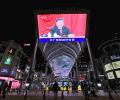
Support from the committee gives Xi an indefinite extension on the reins of power, which will surely result in hawkish and insular policies. It does not bode well for relations with the USA, or with anyone else who does not bow the knee to Beijing, for that matter.
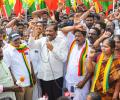
The ruling DMK in Tamil Nadu had begun seeing Governor Ravi's decisions and actions as a part of the state BJP's non-stop criticism of its government and directed from Delhi, a view strengthened by the governor's decision to return the NEET exemption bill, points out N Sathiya Moorthy.

Four Chinese soldiers were killed in the fierce clash with the Indian Army in the Galwan Valley in eastern Ladakh in June last year, the People's Liberation Army (PLA) acknowledged for the first time on Friday.

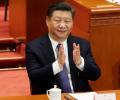
Xi has already been elected as general secretary of the ruling Communist Party of China at its once-in-five-year congress in October last year.

Important for India was Xi's meeting with representatives of PLA officers and soldiers stationed in Tibet. The video of the encounter was interesting to watch, especially the large number of lieutenant generals and major generals, observes Claude Arpi.

To rise quickly in the PLA's hierarchy, you need to be close to Xi Jinping. Retired RA&W officer Jayadeva Ranade on the changes in China's military leadership.
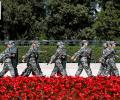
China on Friday hiked its defence budget to $209 billion, maintaining a single-digit growth for the sixth consecutive year with a 6.8 per cent increase in 2021.

At a time when Donald Trump is making belligerent noises, Chinese President Xi Jinping responds by overhauling the People's Liberation Army and restructuring the command of the PLA Navy to emphasise Beijing's resolve to dominate the South China Sea.

'Why did your generals try to grab a few square kilometres of Indian territory in Ladakh?' 'And what happened to the hard work that you and Prime Minister Modi put into the Wuhan and Mamallapuram meets?' Claude Arpi writes a letter to Xi Jinping, China's self-styled supreme leader, who turns 68 today, June 15.
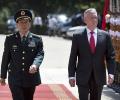
'A hotline between the Chinese and Indian military establishments is essential if the possibility of conflict is to be minimised.' 'When relations are uneasy, even minor incidents can spiral out of control,' warns former senior RA&W officer Jayadeva Ranade.

'The supreme art of war is to subdue the enemy without fighting.' Former RA&W official Jayadeva Ranade explains what China's military reforms mean for the world.
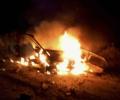
Kejriwal blames Sukhbir Badal for blast, while Sukhbir, Amarinder blame the AAP chief for it.

The ULB polls were also considered as indicative of the voters' mood before the next Lok Sabha elections.

Besides being the President, 62-year-old Xi is already General Secretary of the ruling Communist Party and Chairman of the Central Military Commission.

Of the 15 people who led the 132-year-old party post independence, four have belonged to the Gandhi-Nehru family.

China's highest ranking defence officer will visit India next month, the first such visit in a decade as the Chinese military seeks to expand relations with its Indian counterpart.
'The military officers at China's National People's Congress reflect Xi Jinping's preference for elevating politically reliable, younger, officers with good professional qualifications,' says former RAW officer and China expert Jayadeva Ranade.

'Tibetans will participate in future conflicts with India (in all probability, some were already present in Galwan).' 'As nobody in India would like to have a deadly fight with Tibetan soldiers and officers, the issue needs to be closely followed,' observes Claude Arpi.

'He still has to deal with party norms and traditions and has been careful to follow the order of seniority,' points out Claude Arpi.
The order implied that all government colleges, deemed universities and private medical colleges would be covered under NEET and those examinations which have already taken place or slated to be conducted separately stand scrapped.

What was the need for Xi Jinping, general secretary of the Chinese Communist Party, President of the People's Republic of China and Chairman, Central Military Commission, to don the new role of Commander in-Chief? Does this mean that the most powerful Chinese leader since Mao faces numerous threats from within the Communist Party?
